Roofing Answering Service: Catching Storm-Season Calls
November 2, 2026 · AI Search Authority
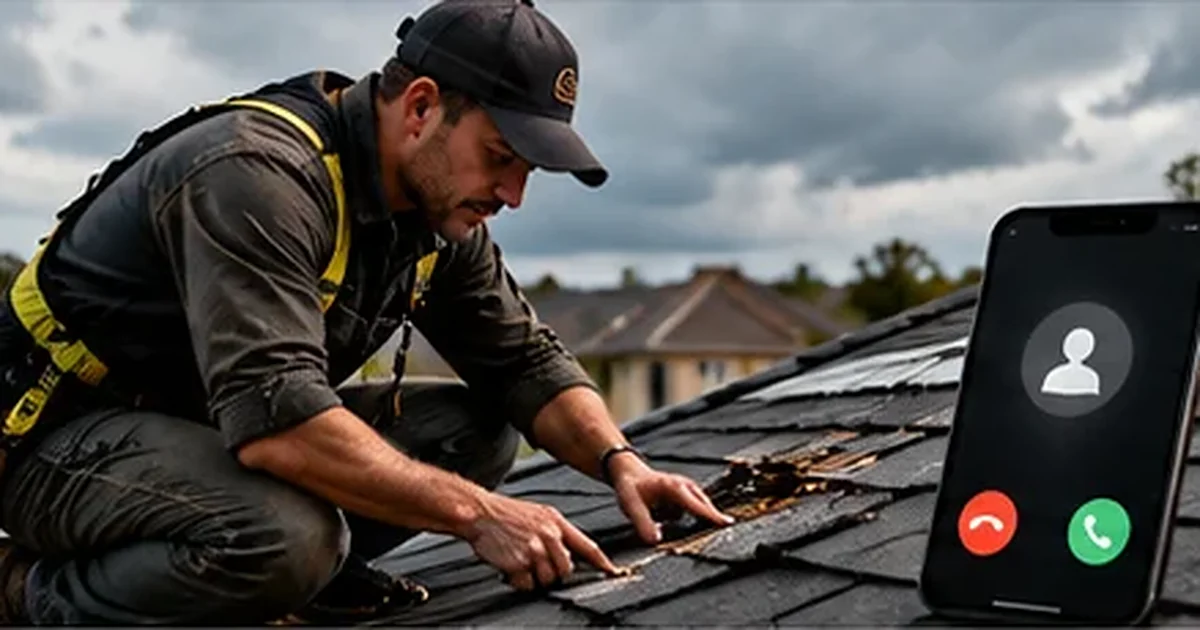
Roofing Answering Service: Catching Storm-Season Calls
A roofing answering service answers while you are on a roof, asks what kind of damage the caller has and whether water is coming inside, and sorts the call into a tarp request, an inspection or an estimate. It matters most in the days after a storm, when every homeowner on the street is calling at once.
Key takeaways
- Storm weeks compress months of calls into days. The phone is busiest exactly when your crew is busiest.
- The first filter is simple: is there water inside the house right now? That one answer separates a tarp from an estimate.
- Insurance adjusters, homeowners and suppliers all call the same number and need different answers.
- The AI books inspections and records damage. It does not promise an insurance outcome or a repair price.
Why are storm-season calls so hard to catch?
Because everyone calls on the same day, and the person who should answer is standing on a ridge.
A hailstorm crosses the county at 4 p.m. By 6 a.m. the next morning the voicemail is full. Neighbors compare notes over the fence, and each one calls three roofers. The first company that picks up often gets the inspection. The one that returns calls on Thursday gets a list of people who already booked someone.
You cannot answer from a roof. You are wearing a harness, the wind is blowing across the phone and one wrong step is a bad day. Even your office, if you have one, is probably also out measuring. The call that comes in at 7:45 on a Saturday morning, when the whole crew is on a job site, is the one that decides your month.
What should the first questions be?
Roofing has an unusual advantage for phone intake: one question gives you most of what you need. "Is there water coming into the house right now?"
If yes, the call becomes a tarp or emergency repair request. If no, it is an inspection or estimate that can be scheduled. The AI then asks:
- What happened? A storm, an old leak that got worse, a missing section, or just age.
- What can the caller see? Shingles in the yard, a dark stain on the ceiling, daylight in the attic, granules in the gutters, a dent in a vent or flashing.
- Where inside is the water? Which room, and whether it is dripping, spreading or just a stain.
- What is the roof made of, and how old is it? Asphalt, tile, metal or flat roof. The caller's best guess is fine.
- Is there an insurance claim open or planned? This tells you whether an adjuster will be involved.
- Address, name, a callback number and a time that works.
These six questions take about three minutes. They give your estimator enough to arrive prepared.
What does a storm-damage call sound like?
Caller: Hi, I've got shingles all over my yard after last night.
AI: I'm sorry to hear that. Is there any water coming into the house right now?
Caller: Not that I can see. There's a stain on the hall ceiling, I'm not sure if it's new.
AI: Thank you. Is the stain damp, or dry and discolored?
Caller: Kind of damp.
AI: Okay, I'm going to flag that for a quick look. Do you have a claim open with your insurance company?
Caller: Not yet, I wanted to get someone out first.
AI: That makes sense. Our next inspection openings are tomorrow at 9:30 or 1:00. Which works better?
Notice what the AI does not say. It does not say the roof needs replacing. It does not say the insurance will cover it. It does not tell the caller to climb up and look.
Which roofing calls are urgent?
| Call type | What the caller says | Urgency | What the AI does |
|---|---|---|---|
| Active leak | "Water is dripping in my living room" | Urgent | Asks about the room and rate, then warm-transfers to the person on duty or books the first tarp or repair slot |
| Storm damage | "Hail came through last night" | Same-day to next-day | Records the visible damage, asks about interior water and books an inspection |
| Missing shingles | "A section blew off" | Same-day if the deck is exposed | Asks if there is interior water and what roof area is bare |
| Tarp request | "Can you cover it until my insurance comes?" | Urgent | Collects the address and roof area; passes to a person for confirmation of the job |
| Insurance claim inspection | "My adjuster wants a contractor on site" | Scheduled | Gets the claim number if the caller has it, adjuster contact and available times |
| Replacement estimate | "My roof is 22 years old" | Routine, high value | Books an on-site estimate; asks about material, size and timeline |
| Repair vs replace question | "Do I need a whole new roof?" | Routine | Declines to answer by phone and books an inspection |
That last row matters. "Do I need a whole roof?" is the most common question, and no responsible roofer answers it over the phone. The AI's job is to turn it into an appointment.
How do adjuster calls differ from homeowner calls?
Adjusters call too, and they sound different.
An adjuster is scheduling a day of inspections across a neighborhood. They want a contractor to meet them at 10:15 on a specific address, bring a ladder and be on time. They are unlikely to chat. They give a claim number, a property address and a window.
The AI should recognize that voice. Give it a short rule: if the caller says they represent an insurance carrier, take the claim number, property address, adjuster name and number, and requested time, then check the calendar. If you do not want the AI committing you to a time slot, have it take the message and flag the call for a person. Be clear in your script that the AI does not discuss coverage, claim amounts or whether a claim will be approved.
How much phone traffic can a storm week create?
Let's use made-up numbers to see how a surge hits the plan.
A normal week brings 20 calls. After the storm, 180 calls arrive in six days, at about three minutes each. That is 540 minutes of conversation in a week.
On Pro, which includes 500 minutes at $80 a month, 40 extra minutes at 25 cents is $10, so the month's bill is $90. On Enterprise, with 1,000 minutes at $150, the same week fits comfortably. On Basic, the 300 included minutes disappear halfway through, and the overage runs 240 minutes at 25 cents, or $60 over the base $50, for $110.
The lesson: ten dollars in overage is nothing next to one signed roof. Pick the plan for your worst month and move down when the storm season passes. There is no contract, so you can adjust. The answering service pricing page shows what each tier includes.
What should the AI never do on a roofing call?
- Never tell a caller to inspect the roof. A homeowner on a wet roof is a liability for everyone.
- Never say the claim will be approved. Coverage decisions belong to the insurer.
- Never name a price. Repair and replacement cost depends on decking, layers, pitch and access.
- Never say a crew is on the way unless a person has confirmed it.
- Never pressure. After storms, some canvassers knock on doors with scripted urgency. Your phone voice should be the calm alternative.
How do you set it up before the next storm?
Write down your storm-week rules before you need them: which days you are booking inspections, how far out you are scheduled, whether you offer same-day tarps, and which ZIP codes you serve. Then tell the AI. When the schedule fills, update it, so it stops offering slots you cannot honor.
You keep your existing number and forward calls to the AI when you are busy or after hours. For the bigger picture on nights and weekends, see our after-hours answering service guide. The roofing industry page shows the configuration for roofers.
Frequently asked questions
Can the AI tell whether the damage is insured?
No. It can ask whether a claim exists and note the carrier and claim number if the caller has them. Coverage decisions belong to the insurer and your estimator.
What if I want to take every storm call myself?
Use the on/off switch. Run the AI when you are on a roof or after hours, and turn it off in the office. Callers who do not reach you get an answer instead of a ringtone.
Does it work if the caller speaks Spanish?
On Pro and Enterprise, yes, with English and Spanish agents. Basic is English only. A neighborhood-wide storm will bring in callers who prefer Spanish, so it is worth deciding in advance.
Can it hand me a call from an adjuster on the spot?
Yes, if you set that rule. The AI can warm-transfer after briefing you on who is calling and why. If you cannot pick up, it leaves the claim number and the best callback time in your dashboard summary.
Before the next hail season
Call (888) 814-1662 and ask about a leaking roof. Hear how it handles the water question. Then read the AI receptionist overview and decide who should answer the phone while you are on the ridge.
Get found in AI search
Our AI Visibility plan gets your business recommended across ChatGPT, Gemini, Perplexity & Google AI — one-time $350.
Explore AI Visibility